
Subscribe, Connect, Learn, Grow:Our Monthly Newsletter Delivers Care Industry Innovation, Critical News, and Insights

NDIS Case Notes are comprehensive records that detail the support provided over a certain timeframe to assist care providers and support workers in planning interventions and evaluating ongoing care for clients. These notes outline the aid given during a shift, keeping health service providers and involved parties informed about a Participant’s progress, and offering a structured approach to writing case notes. Case Notes play a vital role in ensuring higher levels of care by enhancing planning, assessment, and communication among care providers, support workers, and stakeholders.
Within the domain of NDIS Participant management, communication acts as the guiding compass, while Case Notes serve as the intricate map illustrating the path forward. The NDIS fundamentally revolves around enhancing the management of individuals, each on a distinct and personal journey toward improving their quality of life. At its core, the NDIS emphasises support founded on detail, individuality, and, most importantly, dignity.
Taking this perspective into account, the significance of Case Notes becomes evident in NDIS Participant management, especially as a Provider’s success heavily relies on the Participant’s satisfaction derived from consistent, rejuvenating service delivery. As Support Workers assist the Participant over time, collecting detailed histories demands a tool that organises support information chronologically as a minimum. Additionally, a software solution that’s quick, easy to use, and user-friendly is essential.
The NDIS has strict conditions relating to what is captured about NDIS support. These details form the basis of the NDIS Case Notes.
Documentation guidelines for support delivery:
Expanding upon the minimum identifying information, specific documents should include:
Details of the support type (including ratio/intensity) provided, along with a signature from the Participant, nominee, or carer confirming receipt of each support instance.
Activities undertaken, staff-to-Participant ratios, and a record of Participant attendance as per the schedule.
Detailed account of activities undertaken and their relevance to the specific support item and Participant goals.
Information outlining the schedule, cost, nature, and quality of supports to be delivered, as well as expected outcomes.
Items like continence products, home modifications, assistive technology, and other capital supports should be invoiced. In some cases, invoices, assessments, or reports with basic details might not need extra proof of quantity or the type of support provided.
The table below provides further information regarding the support category, specifying the type of support and the necessary details required if the task is completed.
For further information, please view this downloadable guide from the NDIS.
Different types of Providers under the NDIS might have specific details in their Case Notes, depending on the services they provide. For instance, the notes from an Audiology Provider might differ from those of a Support Coordination or Supported Independent Living Business. Apart from the required NDIS standards for Case Notes, what gets written and stored depends on the provider and their staff’s training.
Regarding case note templates, you might start by meeting the NDIS requirements and manage Case Notes using a general software like Excel. However, there could be limitations where such software may impede rather than assist, making it challenging to access notes externally or swiftly. That’s why numerous NDIS Providers opt for purpose-built NDIS Software for Providers. This specialised software not only fulfills NDIS Case Note requirements but also includes extra tools. These additional features may allow for document and image attachments and offer filtering options based on categories or time, streamlining the process.
Besides being a requirement for Providers working in the NDIS, meticulously crafted progress records serve as a fundamental pillar in achieving NDIS quality benchmarks, ensuring legal safeguards, and enhancing the quality of care within disability services. Progress documentation plays a pivotal role within official records, keeping healthcare professionals and family members informed, and being essential for audits, investigations, and legal proceedings.
Additionally, these records act as a compass for healthcare professionals, aiding them in aligning with Participant goals and facilitating the delivery of top-tier service. They serve as a vital conduit, keeping families, healthcare providers, coordinators, managers, and team leaders well-informed about a patient’s condition, requirements, and daily routines.
Moreover, the particulars captured in these progress records are instrumental in formulating detailed client NDIS progress reports. These comprehensive reports play a pivotal role in aiding NDIS or disability care decision-makers by offering insights for monitoring care progress and conducting plan reviews.
Incorporating prescription medication information for diverse vulnerable groups, including individuals with mental health challenges or terminal illnesses, demands secure notes that can be locked and accessed only by specific groups—a crucial feature offered by CareMaster software for NDIS Providers. The significance of Case Notes cannot be overstated; it stands as one of the pivotal elements in managing an individual’s health.
You needn’t document every shift detail; focusing on key facts suffices. When familiar with client habits, note any deviations. Clear, understandable Case Notes matter as they’re regularly reviewed by stakeholders in Participant Management. Providers often train staff and set guidelines for quality notes to aid subsequent support services. These notes aim to streamline Participant management and simplify support for all involved. Implementing a software solution for Case Notes aims to mitigate risks tied to relying on memory for Participant history. It enables accurate management of multiple support services simultaneously.
Reviewing Case Notes is most effective before a shift begins and at a point during the shift when an update is necessary based on the notes. This ensures any significant information relevant to the Participant’s Progress, like their NDIS goals, is noted and considered in context.
Here are some actionable tips to improve your Case Notes when working with NDIS Participants.
Focus on important details without overwhelming the notes with unnecessary information.
Writing good progress notes involves sticking to the facts—what you saw, both good and bad, what you did, and what happened before or after. Use clear, descriptive language without making assumptions or judgments to write good and concise progress notes.
Include details that are pertinent to the client’s progress and goals and those who manage the Participant.
Write notes promptly after the session while the information is fresh.
Follow a standardised format to ensure uniformity and easy comprehension for all stakeholders.
Keep the client’s perspective in mind, focusing on their needs, achievements, and challenges.
Adhere strictly to confidentiality guidelines when documenting sensitive information.
Regularly review and update notes to track progress accurately over time.
Applying these suggestions can notably improve the quality and efficacy of progress notes, especially within the scope of providing NDIS supported care. This resource from the University of Adelaide could be valuable in training staff to understand the advantages of employing objective writing methods.
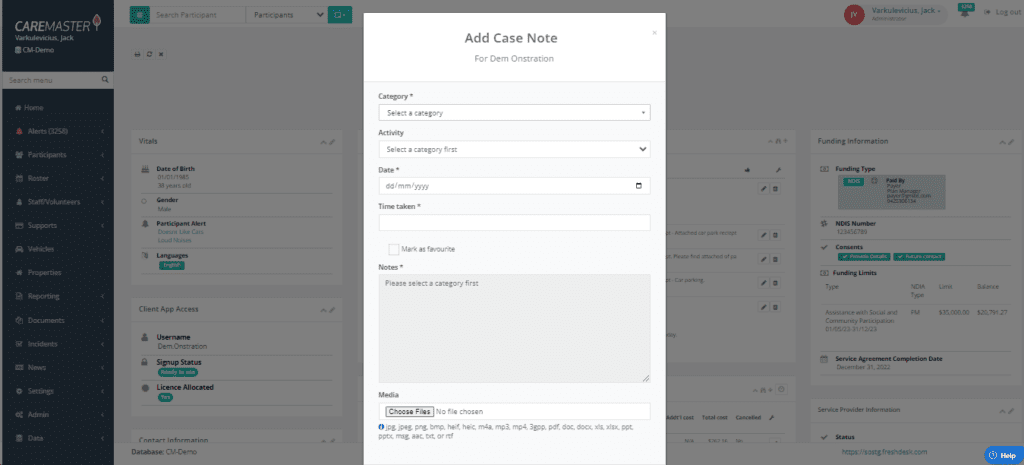
The image displayed below illustrates the interface of CareMaster NDIS software for Providers, showcasing several mandatory fields that capture the necessary information specified by the NDIA.
To understand the CareMaster Case Notes feature thoroughly, it’s essential to grasp how the CareMaster software is utilised by various individuals within a Provider’s framework. Different stakeholders, such as support coordinators, disability Support Workers, healthcare professionals, and administrators, interact with the software, leveraging its functionalities for distinct purposes. Each user’s role and responsibilities shape their utilisation of the Case Notes feature, offering insights into how this tool contributes to streamlined operations, Participant engagement, and comprehensive care management within the NDIS framework.
Support Workers, as the primary scribes of Case Notes, leverage the CareMaster Support Worker App for both accessing and inputting new Case Notes examples for support workers. This mobile application enables them to seamlessly read existing Case Notes while on-site with Participants and efficiently input new information directly into CareMaster. By utilising this app, Support Workers ensure real-time updates and accurate documentation of participant interactions and support activities, contributing to the comprehensive and immediate recording of vital information within the NDIS framework.
Support Coordinators play a crucial role in utilising CareMaster’s sample Case Notes within the NDIS framework. Their responsibilities involve overseeing and coordinating the support provided to NDIS Participants. Support Coordinators rely on Case Notes to gain insights into the Support Workers’ interactions, Participant progress, interventions implemented, and any critical incidents documented. They use these records to monitor the overall quality of care, track Participant goals, and ensure that the support provided aligns with individualised plans. Case Notes serve as a valuable tool for Support Coordinators to review and assess the Support Workers’ activities, facilitate communication among team members, and make informed decisions regarding Participant care and future planning. Additionally, they may use these notes to generate reports, analyse trends, and ensure compliance with NDIS requirements. Overall, Case Notes are instrumental in aiding Support Coordinators in effectively overseeing and optimising the support provided to NDIS Participants.
Healthcare professionals, including mental health experts and allied health practitioners, play pivotal roles within CareMaster’s Case Notes feature in the NDIS environment. These professionals, such as therapists, nurses, specialised care providers, mental health specialists, and allied health experts like physiotherapists or occupational therapists, contribute specialised insights and interventions essential for participants’ well-being.
Within Case Notes, healthcare professionals document intricate details of their interventions, assessments, and tailored care plans. These entries serve as a repository for specialised healthcare and therapeutic strategies, ensuring holistic and comprehensive care delivery. Moreover, they meticulously record sensitive information, such as mental health evaluations or specific therapeutic interventions, which can be locked and made visible only to authorised and qualified practitioners. This security measure ensures confidentiality and restricted access to highly personal and sensitive details, maintaining the integrity of Participant records.
These professionals play a crucial role in leveraging Case Notes for collaborative efforts, sharing vital health insights, and contributing to tailored care plans for Participants. Their meticulous documentation not only tracks progress but also ensures alignment with prescribed protocols, promoting high-quality and individualised care within the NDIS framework. Case Notes serve as a secure platform, empowering healthcare professionals to deliver precise interventions and therapies essential for Participants’ overall health and well-being.
Provider administrators play a pivotal role in leveraging CareMaster’s Case Notes to oversee and manage the overall operations within the NDIS framework. They use Case Notes as a means to review and ensure the accuracy, completeness, and compliance of the documentation entered by Support Workers and coordinators. Administrators often utilise these records to monitor the quality of care delivered, assess service provision against NDIS guidelines, and maintain the integrity of Participant records.
Additionally, administrators may use Case Notes for various administrative tasks such as generating reports, conducting audits, and analysing trends in Participant care. They rely on this documentation to facilitate decision-making, identify areas for improvement in service delivery, and ensure that all regulatory requirements are met.
Furthermore, administrators may have exclusive editing privileges within Case Notes, enabling them to make necessary adjustments, review entries, or delete erroneous information. Overall, Case Notes serve as a critical tool for Provider administrators to maintain oversight, compliance, and operational efficiency within the NDIS context.
CareMaster offers a versatile and customisable approach to Case Notes through its tailored fields feature. These custom fields empower users to capture specific and nuanced information relevant to their unique business requirements. Whether it’s recording specialised activities, additional Participant details, or specific service-related information, CareMaster’s custom fields enhance the depth and breadth of Case Notes. This customisation capability ensures that Providers can effectively document and track essential details aligned precisely with their operational needs, promoting comprehensive and accurate record-keeping within the NDIS software.
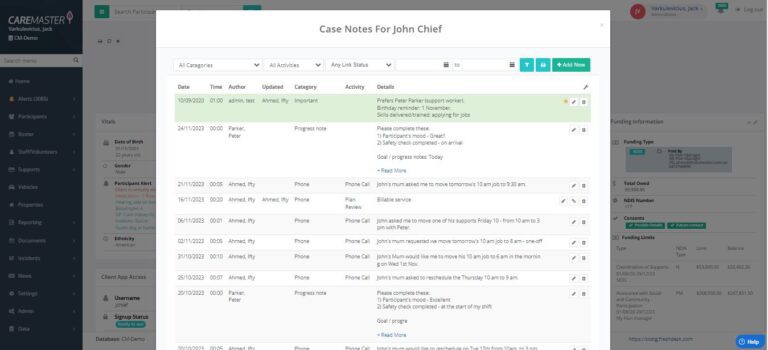
The CaseMaster NDIS software features a useful filter in the Case Notes section, simplifying the search for specific details. Users can categorise Case Notes, such as tagging phone conversations as “Phone Calls.” This categorisation aids in swiftly locating all associated Case Notes related to phone calls. Businesses have the option to customise these filters to suit their reporting requirements. Categories such as Activity type, Email, Incident report, and others are at their disposal. CareMaster also enables users to search notes by date and linked activity status using a calendar. With its adaptable features, CareMaster ensures users efficiently access the precise information they need, saving both time and effort.
The NDIS Case Note Content includes key information like author details, creation and update timestamps, selected category for filtering, and reporting. It covers specifics such as activity type, service organisation, service type, NDIS claim overview, unit costs, and charge costs per hour. Each Case Note is associated with unique identifiers like case and client numbers. Users can mark a case note as a favourite, highlighted in green for quick access, especially for vital updates like medication changes. Other features include privacy settings, media file attachments, icons denoting attachments, and linking case notes to specific supports. Administration holds the authority to delete case notes. Importantly, only administration licenses possess editing capabilities post-submission through the Support Worker app. This control measure ensures accountability, structured management within Provider businesses, and upholds the integrity of client records by maintaining accurate and reliable Case Note information.
CareMaster’s reporting section in the Participant feature allows users to generate NDIS Case Note reports, exportable in formats like .csv or .PDF for detailed analysis. Users can apply filters based on category, date range, Support Worker, or worker groups for specific reports. Customisable formatting options are available for administrators creating reports, aiding in tasks like supplying medication-related case notes to family or medical practitioners for review. CareMaster’s Participant Case Notes result from collaboration, catering to NDIS Coordinators and Plan Managers. It offers flexible note creation, seamless data sharing, and time-saving tools. The system enables easy Participant access, smart name loading, dashboard views, and custom note categories for efficient filtering and reporting. Only administration licenses can edit case notes to maintain data integrity, while frontline workers use a dedicated app to submit notes. Audit tracking, activity and Support Worker filtering, direct invoicing, and diverse file uploads streamline case management within the CareMaster platform. For deeper insights into CareMaster’s capabilities like award interpretation and payroll integration, personalised demonstrations are available through contacting CareMaster directly.
In conclusion, the merits of maintaining excellent NDIS Case Notes are manifold: fostering clearer communication, deeper comprehension of client needs, enhanced planning for ongoing support, compliance with legal standards, and ensuring seamless care continuity. These comprehensive notes serve as a cornerstone, elevating collaboration, decision-making, and the delivery of top-tier care within the NDIS framework. For more information relating to CareMaster’s NDIS Case Note software click here: https://caremaster.com.au/features/ndis-case-notes/
For a practical demonstration of how CareMaster streamlines this process, arranging a software demo could provide valuable insights into optimising your case note management.


CareMaster would like to acknowledge the Traditional Custodians of the land on which we operate, and pay our respects to their Elders past and present.