
Subscribe, Connect, Learn, Grow:Our Monthly Newsletter Delivers Care Industry Innovation, Critical News, and Insights

The NDIS offers crucial financial support to individuals facing enduring and substantial disabilities, enabling them to access essential services for a fulfilling life.
Each Participant under the NDIS receives a personalised plan outlining their goals, allocated support, and granted funding. Providers play a pivotal role as primary liaisons for NDIS Participants.
The NDIA determines eligibility for NDIS participation and allocates funding based on the NDIS Act 2013. This legislation outlines the reasonable and essential supports and services eligible for NDIS funding.
An NDIS participant is an individual living with a disability who qualifies for and is enrolled in the National Disability Insurance Scheme (NDIS). They have an approved plan tailored to their specific needs and goals, outlining the supports and services funded by the NDIS to enhance their independence, well-being, and participation in the community. Participants actively manage their plans, choosing the providers and services that best suit their requirements.
A registered NDIS provider is an organisation or individual accredited by the National Disability Insurance Agency (NDIA) to deliver services and support to NDIS participants. These providers meet specific quality and safety standards set by the NDIS, ensuring that their services are aligned with participant needs and delivered to high standards of care and professionalism. Being registered allows them to offer services to NDIS participants and receive payment for those services through the NDIS.
Non-registered providers within the NDIS framework operate without direct accountability to the NDIA, the federal agency managing the NDIS. As a result, they exist beyond the agency’s investigative purview and are unable to directly serve participants managed by the NDIA, potentially limiting their expansion and access to a wider participant base.
NDIS Service Providers play a critical role within the framework of the NDIS, offering essential support and services that empower Participants to work towards their objectives.
These Providers have the option to be either registered with the NDIS Quality and Safeguards Commission (NDIS Commission) or operate as unregistered entities.
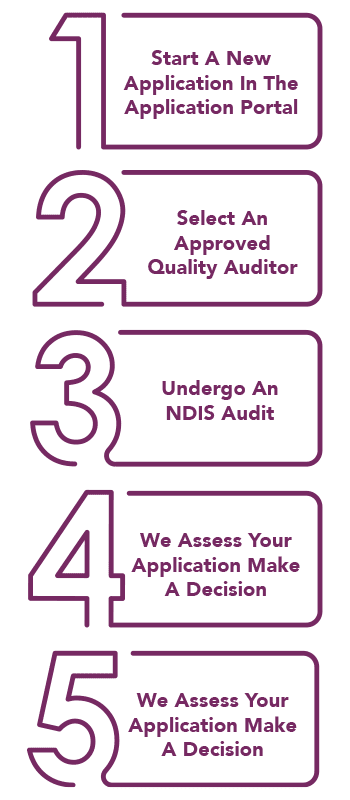
If you’re looking for how to become an NDIS provider, the first step is to start an application.
When signing up as a registered NDIS provider through the Application Portal, follow these steps:
Please note that currently, the NDIS provides you with up to 60 days to exit the Portal and return to finish your application at your convenience.
Once you’ve submitted your online application, the NDIS Commission will email you an ‘initial scope of audit’ document summarising what your organisation needs for registration. This document clarifies whether you’ll need a ‘verification’ or ‘certification’ audit and outlines the requirements to meet the NDIS Practice Standards.
As the applicant, it’s your responsibility to hire an approved quality auditor for the audit process. You can reach out to multiple auditors for quotes, using the ‘initial scope of audit’ document as a reference. Discuss your specific needs and negotiate to ensure you get the best value for your organisation.
Once you’ve engaged an approved quality auditor, they’ll verify the accuracy of the audit scope and commence the audit process. The methods employed differ between ‘verification’ and ‘certification’ audits. Auditors take into account your organisation’s size, scale, and the complexity of services offered during their evaluation. Throughout the audit, the auditor works alongside you, explaining their findings and allowing room for any questions or clarifications you may have. Subsequently, they submit the audit results to the NDIS Commission using an online portal.
When reviewing your registration application, the NDIS Commission evaluates the audit results and conducts a suitability assessment of both your organisation and its key personnel.
Processing times vary based on factors such as organisation size, service complexity, and support range offered, leading to differing application processing durations.
The fifth and final step in how to become an NDIS provider is the application outcome.
Successful NDIS Provider Applicants will obtain a registration certificate detailing the services or supports they’re authorised to offer, the registration duration, and any specific conditions to maintain their registration. Once you’ve successfully become an NDIS provider, you can get the Caremaster NDIS software for providers.
Unsuccessful applicants have the option to request a review from the NDIS Commission within three months of the decision. If the outcome remains unfavourable after this review, they can pursue a further review through the Administrative Appeals Tribunal.
Plan managers and support coordinators play a pivotal role in establishing and overseeing links between NDIS beneficiaries and their support systems. Their aim is to empower participants by enabling them to make self-directed choices and access valuable support services.
Individuals enrolled in the program have the option to select a certified plan management provider to handle the management and allocation of funds for the support services outlined in their plan.
A support coordinator collaborates with Participants to curate a blend of support services aimed at enhancing your ability to sustain relationships, handle service-related responsibilities, foster greater independence, and actively engage within your community. Specialist support coordination represents an elevated tier of support coordination services, offering a higher level of assistance and guidance.
The NDIS Partners in the Community initiative plays a vital role in implementing NDIS on a grassroots level within local communities. To ensure effective implementation, the NDIA collaborates with experienced and qualified community organisations that possess in-depth local insight into the requirements of individuals with disabilities or developmental delays.
These partners are instrumental in providing Local Area Coordination (LAC) services, acting as primary NDIS contacts for individuals over the age of seven. Meanwhile, specialised early childhood partners focus on delivering the early childhood approach tailored for children under seven years old.
Partners specialising in the early childhood approach extend tailored support to children under the age of nine who have disabilities or children under six with developmental concerns or delays. Their role involves facilitating access to personalised services and supports that address the unique needs of the child and their family. This includes linking them with local services like community health programs, playgroups, and other area-specific activities.
Early childhood partners offer informational resources, assist in connecting children to appropriate local supports, provide short-term early childhood assistance, and aid families or caregivers in applying for NDIS-funded plans when children require longer-term early childhood support. To learn more about these specialised services for children under nine, explore additional details about the early childhood approach and available support options.
The NDIS is a significant reform empowering people with disabilities in inclusive settings. The Provider Toolkit explains the NDIS structure, funded supports, and provider roles, facilitating support for all participants while guiding the provider pathway.
The National Disability Insurance Scheme (NDIS) stands as a monumental social and economic reform, empowering individuals with disabilities to pursue their aspirations within inclusive communities and workplaces. This overview delves into Section One of the Provider Toolkit, elucidating the NDIS framework, the interactions individuals with disabilities have within it, and the pivotal roles of various stakeholders, including registered providers. The toolkit also clarifies funded supports and services, delineating what is and isn’t covered while highlighting provider roles in assisting participants across different plan types.
Becoming an NDIS provider opens avenues to support all participants, irrespective of their plan type, alongside granting access to tools and support within this transformative initiative. Although encountering unfamiliar terms like LACs, ECEIs, and SDAs may seem daunting, the toolkit offers simple descriptions and a glossary in the Key Resources section to clarify any uncertainties. Admittedly, navigating through the NDIS brings about substantial changes for both providers and individuals with disabilities. However, these adjustments ultimately benefit the disability community and service providers at large.
Encouraging colleagues or those engaging with individuals with disabilities to explore the Provider Toolkit videos offers a deeper understanding of the NDIS functionality. Ultimately, the core essence of the NDIS revolves around furnishing the necessary support for individuals with disabilities to fulfil their aspirations and actively engage in their communities and workplaces, fostering an ordinary life experience. Always remember the Key Resources and Help and Support sections serve as valuable references for additional information.
Whether you’re starting or advancing along the provider pathway, the Toolkit aims to enhance comprehension of the NDIS and outlines steps toward a successful integration.


CareMaster would like to acknowledge the Traditional Custodians of the land on which we operate, and pay our respects to their Elders past and present.